[LOOVIC] Placing Words in Space for Auditory Guidance: An Autonomous Task-Support Platform Eliminating One-on-One Training
現場の疲弊と7割の早期離職を防ぐ:指導者の「短期記憶の限界」を埋めるタスク支援
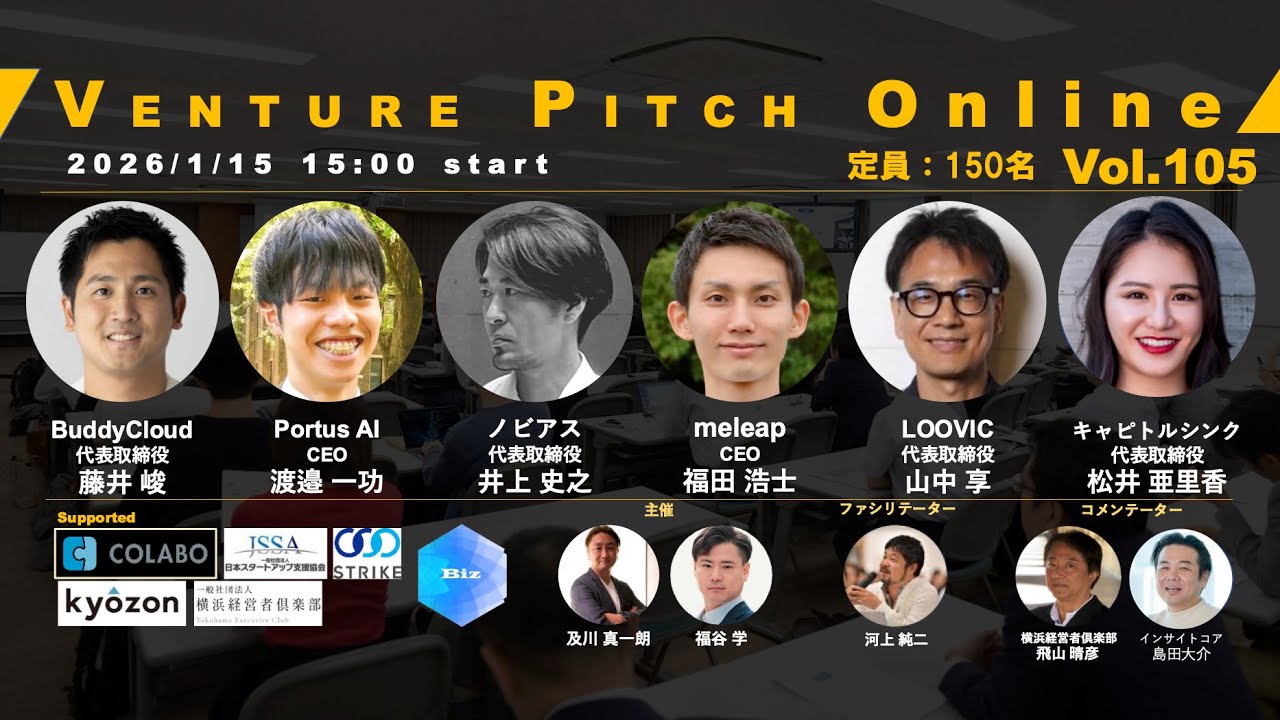
Hello everyone. I am Takahiro Yamanaka, CEO of LOOVIC. Thank you for having me today.We are a startup developing an autonomous task-support platform (a substitute for memory) that enables experts to leave audio notes in physical spaces, providing real-time auditory guidance to learners without the experts needing to be physically present.
In many operational environments, simply assigning a task by saying "do this" or showing training videos beforehand is rarely effective. The sheer volume of information often exceeds a beginner's short-term memory, leading to errors and incomplete tasks.
As a result, managers and experienced staff must stay glued to the side of new hires, straining their own schedules and often working unpaid overtime. This high-stress environment on both sides contributes to a severe turnover issue, where up to 70% of new hires quit within their first year in industries like food service and manufacturing.
We automate this hands-on training process. By doing so, we eliminate the high labor costs associated with manual onboarding and free up to 30 hours of training time per week for managers.
10秒でマニュアル作成。空間に「言葉の粒」を配置するだけで耳元に伴走音声が流れる技術
The mechanism of LOOVIC is incredibly simple.Using a smartphone, an expert records and places short, 15-second audio tasks (what we call "particles of words") in specific physical spaces. When a worker wearing a smart watch or carrying a phone or tablet approaches that space, the task instructions automatically play in their ear alongside a still image on their device screen.
For example, on a manufacturing floor:
As a worker approaches a specific assembly station, they hear:
"We will work here today. First, process the screw in front of you. Once finished, turn it to the right to complete."
The instructions play sequentially in their ear every 15 seconds, precisely when and where they need them.
This DIY active learning system allows workers to naturally learn on the job by doing, rather than trying to memorize dense training manuals beforehand.
200万円の動画作成は不要。使えば使うほど自動更新され現場に馴染むDIY型モデル
Many companies spend significant resources creating photos and videos for process standardization and ISO compliance. However, outsourcing a training video can cost up to 2 million yen (approx. $14,000 USD) and take over a week to complete. Furthermore, if a process changes slightly, the company must spend the same time and money to redo the video. Consequently, most of these videos go unused.With LOOVIC, frontline workers can combine a photo and an audio task on their smartphones to create a manual in just 10 seconds.
If the operation changes, the text can be edited and updated instantly. Unlike video manuals that only look cleaner, our tool actively helps resolve the tasks. This is why LOOVIC achieves exceptional retention rates on the shop floor.
ホテル、製造、介護からインフラまで。特許技術を武器にグローバル市場へ展開
LOOVIC is highly versatile. It has already been introduced across manufacturing plants, logistics warehouses, care facilities, utility maintenance sites, retail showrooms, and supermarkets where stock protocols change daily.Recently, we have seen strong demand from the hotel industry. Hotel operations involve more than 1,000 detailed tasks (cleaning, bed-making, amenity restocking), and training resources are severely limited. With LOOVIC, even foreign staff who do not speak the local language can perform cleaning tasks with high quality from day one, guided by audio instructions in their native tongues.
We have secured robust patents both in Japan and internationally covering our "spatial cognitive audio placement" technology. This provides a strong competitive barrier against copycats and ensures a clear path for global expansion.
使う側は無料、作る側は月額3,000円。PLGモデルで2029年IPOへドライブをかける
Our business model is simple. Workers receiving the tasks (viewers) use the platform completely free of charge. We only charge the creators (editors) starting at 3,000 yen (approx. $20 USD) per month.Similar to Zoom, when viewers realize they want to create their own tasks to instruct others, they convert into editors. This drives self-sustaining, viral growth without heavy sales resources—a true Product-Led Growth (PLG) model.
Currently, we have a pipeline of over 50 commercial deals in progress. We were also selected for Tokyo's "POC Ground Tokyo" validation program, receiving a 10 million yen grant to conduct pilot studies.
By leveraging this PLG model, we aim to scale rapidly and achieve IPO in 2029 with projected revenues of 4.8 billion yen.
In the future, we plan to expand LOOVIC into a skill-sharing marketplace where experts can package and sell spatial tutorials (e.g., home repairs, DIY tips). We look forward to creating a future where people can support one another across time and space. Thank you very much.
質疑応答・フィードバック
富山氏(コメンテーター): Thank you, Mr. Yamanaka. I’ve heard your pitch before, but seeing how much the product has evolved and focused is fantastic.
This is undoubtedly the ultimate tool to combat labor shortages. While you focused on manufacturing today, I often consult for hospitality and construction businesses where complex training requirements lead to high turnover. Can LOOVIC be applied to these sectors?
山中氏: Thank you. Yes, hospitality and construction are prime markets for us. Traditional videos are passive, but our tool delivers instructions right to the worker's ear as they approach the work area, helping them manage over 1,000 complex tasks without burning out. We are already in discussions with several hotel operators.
富山氏: What kind of cost savings or efficiency gains can clients expect?
山中氏: While custom training videos cost 2 million yen, our PLG model allows teams to start for free with a DIY approach. Since our patents are secured internationally, it also drastically cuts training costs for foreign workers.
富山氏: Having international patents is a massive asset for global scaling. Can you integrate with local chambers of commerce or financial institutions in regions like the Keihin Industrial Area in Kanagawa to drive hands-on adoption for local factories?
山中氏: Absolutely. While the system is designed as a DIY tool, we do offer hands-on onboarding support for initial setups. We have a workflow ready to distribute informational materials through local banks and chambers, combined with online onboarding webinars.
富山氏: Having both viral platform growth and high-ticket hands-on enterprise integration is a powerful combination. It could easily scale into multi-million dollar deals. We look forward to your success.
山中氏: Thank you. We will drive our revenues forward.