【Material Gate Inc.】"Single-Molecule Dielectric" to Drastically Reduce Semiconductor Power Consumption. Challenge of a Hiroshima University Chemical Startup Saving the AI Era from Power Crisis
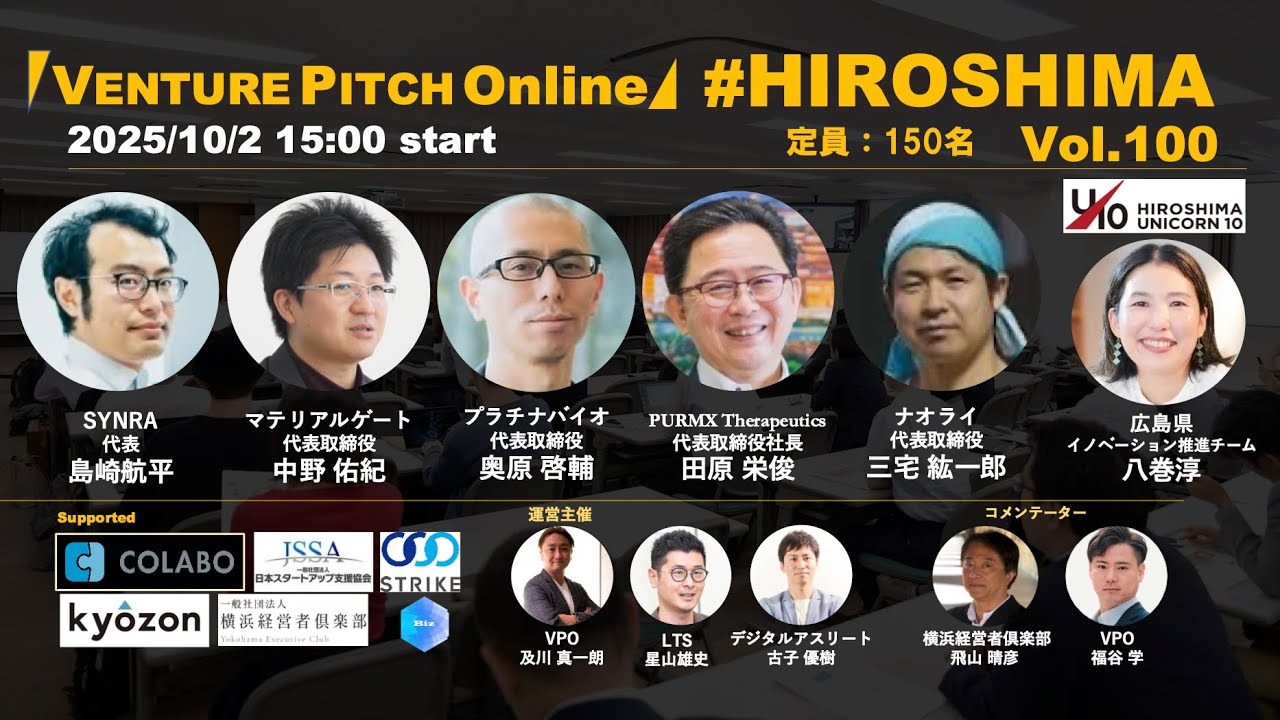
Solving AI's Power Explosion with the Power of Materials. Challenging the Practical Application of Single-Molecule Dielectrics with Professor Nishihara of Hiroshima University
Thank you very much, everyone. My name is Yuki Nakano, Representative Director of Material Gate Inc.
As introduced at the beginning, our company is a deep-tech startup originating from Hiroshima University. Founded in 2023, we are currently in our third year. As a chemical manufacturer, our main business is the production and supply of a nano-material called "single-molecule dielectric" which we researched and developed. Currently in the seed round, we completed our first fundraising about a year ago and are running our development and management with capital of 73 million yen.
Professor Nishihara of the Faculty of Science, Hiroshima University, is one of our co-founders. Material Gate was established to commercialize a very unique material called "single-molecule dielectric," for which he published basic research papers around 2017 to 2018, receiving extremely high academic evaluations.
I was originally a student (a member of the research lab) of Professor Nishihara. After graduating from university, I worked for private companies for about 10 years to gain business experience. However, with the desire to popularize this highly interesting material from the university through the power of business without letting it fade away, I joined forces with the university's technology again and started this company.
In starting our business, we received comprehensive support from Hiroshima Prefecture. Beginning with our selection for the "Hiroshima Unicorn 10" project, we received strong support and networks from the Hiroshima Startup Promotion Organization (J-Startup EIGHT) and Hiroshima Bank (Hirogin), which prepared the base for our commercialization. Currently, we are a team of about 15 members, and most of them are excellent researchers and engineers who have connections with academia such as universities.
Our corporate philosophy is "creating the future with the power of materials." Historically, the international competitiveness of Japan's material industry and chemical manufacturers has been extremely strong, and excellent materials have been the source of innovation for devices and semiconductors. With the strength of materials as our axis, we want to deliver products to the world that update the semiconductor and electronic device industries.
The social issue we are challenging to solve with the power of materials is the "reduction of semiconductor power consumption" accompanying the rapid spread of AI.
The evolution of modern generative AI and data centers is remarkable, but on the other hand, the amount of electricity consumed to run them is increasing by orders of magnitude, causing great concern as a bottleneck for the global energy crisis. To reduce power in the AI era, we bring a breakthrough through the "power of materials" rather than just device design or circuit modifications.
Drastically Cutting DRAM Power. Mounting a New Material that Stores Electricity at the Nano-scale onto Cutting-edge Semiconductors
The target we are focusing on is reducing the power consumption of "memory," which is the storage device in computers.
Currently, among all computer memories in smartphones, PCs, and servers, the one that consumes the most power is "DRAM," manufactured by major semiconductor companies. DRAM is a very high-speed, high-density, and high-performance memory, but it requires constant electrical current flow (refreshing) to maintain information, and its large power consumption is a technical weakness.
The new material developed by Material Gate has the potential to dramatically cut the power consumption of next-generation memories like DRAM just by incorporating a small amount of it.
To put it simply, a single-molecule dielectric is "a material capable of storing (retaining) electricity at the molecular level, in a microscopic size." By storing electricity, the inside of the material is divided into positive and negative charges, and by maintaining this polarization state, we can realize a memory (ferroelectric memory) that continues to record "0 and 1" data even if the electricity is cut off.
In fact, research on memory using "dielectrics" that store electricity has existed for a long time. However, conventional materials had a physical limitation (bottleneck) in that their properties (ability to retain electricity) were lost when they were made smaller (thinner), making it impossible to mount them on cutting-edge, ultra-fine semiconductor processes.
In contrast, our "single-molecule dielectric" has the amazing property that its excellent electrical retention characteristics do not deteriorate at all even when miniaturized and thinned to the nanometer scale. This is the world's only solution that enables mounting ferroelectric memory on cutting-edge fine semiconductors. The actual substance is a powder like white salt, manufactured by properly synthesizing raw materials.
Our business model assumes a style of supplying a "device design and precision processing technology" package as a "technology license (intellectual property)" to semiconductor and device manufacturers worldwide, in addition to manufacturing and selling the "single-molecule dielectric" material itself.
Currently, we have two business axes.
One is the "semiconductor memory" business, which uses national projects to proceed with long-term research and development. Because semiconductor memory has an extremely large market impact but requires time to develop, we are advancing joint design with major manufacturers under strong financial support from the government.
The other is the "capacitor" business, which has lower technical implementation barriers and is ahead in practical application. Capacitor manufacturers and user companies are testing devices using our materials, and both businesses find high appeal in the "overwhelming miniaturization and power reduction of devices."
Licensing Business via Fabless Strategy. The Ambition to Replace the Entire Giant Memory Market
We do not intend to have huge semiconductor manufacturing lines or cleanrooms ourselves, but rather aim for business expansion through a thorough "fabless" strategy.
This is because it is physically impossible for a startup alone to own manufacturing lines equivalent to TSMC or mega-foundries. We will hold the core material synthesis know-how and precision processing package system as black-boxed assets (patents and technology licenses), and entrust actual device mass production to partner semiconductor foundries, thereby approaching the global market speedily and efficiently.
The memory market is a super-giant market of several trillion yen, needless to say.
Our ambition is to replace all memory worldwide with Material Gate's technology, wiping out the power consumption of servers and devices in the AI era. We will start by carving out social implementation steps from capacitors and limited memory areas with low technical hurdles, and reliably advance into the core of semiconductors.
We are a deep-tech company that fundamentally changes the device structure of the world with the power of materials. We look forward to collaborating with companies suffering from device power reduction issues and investors and partners who will further accelerate our material development. Thank you very much.
Q&A and Feedback
Commentator (Mr. Furuko): Thank you very much, Mr. Nakano, for your very interesting presentation. The explosive increase in data centers and the power consumption issues of AI are themes that the entire industrial world is struggling with today. Material Gate's technology, which approaches this issue from the deepest layer of materials, will be a key technology holding the key to the sustainability of data infrastructure.
As a question from a humanities background who is not familiar with science, regarding this new material "single-molecule dielectric" discovered by co-founder Professor Nishihara, what kind of exclusivity or superiority does your company hold? Can other chemical manufacturers synthesize and manufacture similar materials to copy you, or how are patents and technical black boxes structured?
Mr. Nakano: Thank you for the question.
First, regarding the patents for the material itself (basic patents), there were several influential patent groups originally held by Hiroshima University, but these have now been transferred to us, making them "patents 100% owned solely by our company." Therefore, other companies cannot legally use this patented substance without permission.
Furthermore, the important superiority we possess lies in the "peripheral processing technology" for incorporating the patented material into devices.
In semiconductors, to actually use a new material, the manufacturing process of "how to uniformly coat the material as an extremely thin film on the nanometer scale" and "how to precisely etch the film to leave necessary electrode and circuit patterns" is critically important.
This is a very down-to-earth and highly sophisticated manufacturing technology that is difficult to construct in a university laboratory alone. We have applied for patents for this "precision thin-film processing and etching technology" for our materials, and we deliberately keep some extremely important manufacturing conditions, such as synthesis ratios and temperature control, as "secret know-how (black box)" without disclosing them in patents. With this double protection, we build a solid barrier to entry against other companies.
Mr. Furuko: I see. You not only exclusive basic patents, but also protect the process of processing it into semiconductor thin films with know-how and peripheral patents. I understand very well.
Another point: is this material "extracted" from natural resources like rare metals? If so, I was concerned if geopolitical risks or procurement limitations would hinder scaling. Or is it synthesized and mass-produced in a lab like normal chemical substances?
Mr. Nakano: To conclude, it is not extracted from nature, but is a substance manufactured by purchasing commonly distributed chemical raw materials and chemically "synthesizing" them in labs and factories.
Therefore, regarding raw material procurement, it is theoretically possible to manufacture and increase production without limit.
However, we do use inorganic substances and some metallic elements (minerals classified as minor or rare metals) for the framework of our materials. Therefore, the concern of indirectly receiving the impact of price fluctuations due to export regulations in specific countries or international situations (geopolitical risks) is not zero.
However, the elements used themselves are not extremely special or hard-to-obtain ultra-rare metals, so the risk of a serious trouble that completely stops the supply chain is extremely low, and we have no serious concerns about the procurement system for mass production.
Mr. Furuko: Because it is a compound, it can be mass-produced by synthesis, and because the raw materials are general metallic ones, there are no serious procurement concerns. I am relieved.
The "fabless strategy" shown on the final slide is very rational. Building a semiconductor factory requires astronomical capital investment, but by going fabless, you can focus on core technology and leverage the massive mass production capacity of TSMC and major foundries.
I think it is a wonderful material technology that Japan should be proud of, and it is a solution that fits the AI era perfectly. I look forward to your global licensing expansion. Thank you very much.
Mr. Nakano: Thank you very much.