【Platinum Bio Inc.】Realizing Food Barrier-Free with Genome Editing and Bio-DX. The World's First "Allergy-Reduced Egg" and the Infinite Potential of Bio-Manufacturing
Kewpie Alliance and 630 Million Yen Raised. Hiroshima University Deep-Tech Startup Tackles Social Implementation of Biotechnology
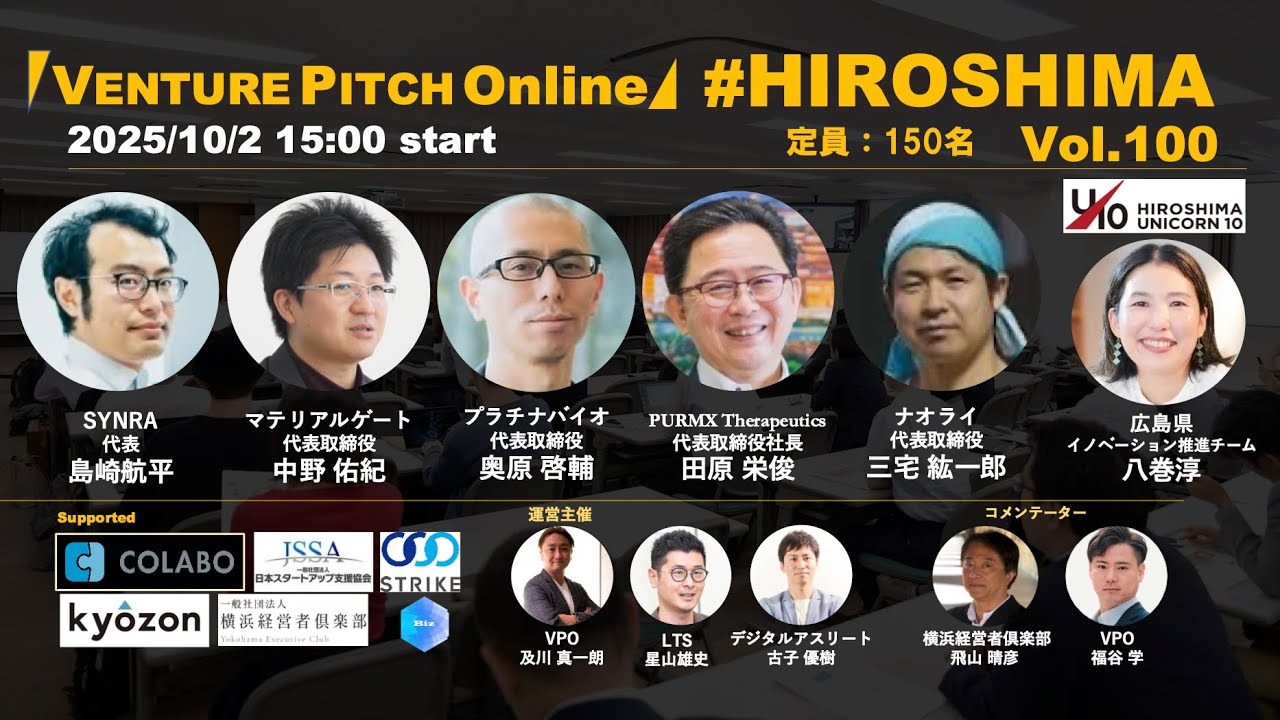
Thank you very much, everyone. My name is Keisuke Okuhara, Representative Director of Platinum Bio Inc.
With our strong vision of "opening the future with biotechnology," we were founded in 2019 as a startup originating from Hiroshima University. Since our founding, we have raised a cumulative total of 630 million yen, mainly from business companies and CVCs.
Our latest major topic is the capital and business alliance with Kewpie Corporation, well-known for its mayonnaise. In addition, we have received investments from various business companies deeply involved in biotechnology and biological resources, such as Yanmar, Tsunetishi Shipbuilding Group, and Food & Life Companies, which operates Sushiro, all of whom support us as strong partners.
Currently, we have a team of 43 members, and our cutting-edge academic and scientific technology base is backed by top-tier domestic academia. Prominent researchers such as Professor Takashi Yamamoto, a front-runner in genome editing, Professor Hidemasa Bono, a leading expert in Bio-DX and bioinformatics, and Professor Horiuchi, the co-developer of the allergy-reduced egg, support us as scientific advisors.
Our core business consists of "Bio-DX (data analysis)" which digitizes various biological functions and genetic information, and technology (breeding and design) to express specific functions based on analysis results or rewrite genetic information using genome editing technology. We develop a platform to design the functions of all living things, from microorganisms to plants and animals, and solve social issues.
Targeting the Main Cause of Egg Allergy. The World's First "Allergy-Reduced Egg" Developed Through Joint Research with Kewpie
The most symbolic product we have developed is the "Allergy-Reduced Egg (ovomucoid-free egg)," which can be eaten with peace of mind even by people with egg allergies. This is the world's first attempt at egg innovation using genome editing.
It was completed through more than 10 years of joint research by Kewpie and Professor Horiuchi, succeeding in completely removing (knocking out) the specific protein "ovomucoid," which is the biggest cause of egg allergy, using genome editing technology.
Egg allergy accounts for about one-third of all food allergies, making it the clear number one food allergy in Japan. Among egg allergens, ovomucoid has the troublesome characteristic of being extremely resistant to heat and acid. Many normal egg allergens lose their effect (become inactivated) when heated, but ovomucoid retains its ability to cause allergies even when thoroughly heated, causing headaches for patients and food manufacturers alike.
The allergy-reduced egg we developed does not contain ovomucoid. Therefore, when this egg is heated and cooked, all other heat-sensitive allergens are inactivated, allowing children and patients with severe egg allergies to safely eat dishes made with real eggs. It is a breakthrough that brings a revolution to the egg field, similar to "gluten-free" in the wheat field.
Currently, we have been selected for the Ministry of Agriculture, Forestry and Fisheries' "SBIR Phase 3 Project" (a research and development support program for startups), receiving a large-scale grant of 1.3 billion yen over four years to rapidly advance its social implementation. Parallel to expanding production scale, we are conducting the world's first clinical study in cooperation with Dr. Ebisawa of Sagamihara Hospital, a front-runner in food allergy treatment.
Recently, NHK featured our project, broadcasting nationwide a scene where a 3-year-old boy named Tomoki, who has an egg allergy, ate the allergy-reduced egg powder in a clinical study and showed a smile without any allergic reaction. We have received immense expectations and feedback as a product that meets the earnest wishes of patients and families who say, "I want my child to eat real eggs," and "I want us to eat delicious food together at the same table someday."
Aiming for "Egg for All." Global Expansion to Replace Eggs Worldwide Beyond Alternative Eggs
Our ambition is not to limit this allergy-reduced egg to Japan.
Currently, plant-based alternative eggs, such as "JUST Egg," a liquid product popular in the United States, are on the market worldwide. However, the biggest issue with plant-based alternative eggs is that they do not taste good compared to real eggs. We aim to replace this large food substitute market with the taste of real eggs by providing real chicken eggs with only the allergens removed.
And beyond that, we plan to shift all eggs worldwide, including commercial eggs used in processed foods like cakes and mayonnaise, to this allergy-reduced egg. We hold the concept of "Egg for All," where everyone, with or without allergies, can enjoy the same real eggs.
Preparations for global expansion have already begun, including market research in the United States, demonstrations in Singapore, a food tech hub, and collaborations with a major local seed company in India, the world's largest food basket. We plan to establish the allergy-reduced initiative in India and then expand to huge global markets like Africa, where food and allergy issues coexist.
In addition, we have a diverse product line utilizing this genome editing and Bio-DX platform, not just the egg business.
For example, we supply genome-edited cells to drug discovery startups, develop "new fish feed using sea farming that does not use genome editing" for stable supply of marine resources, improve the CO2 absorption capacity of microalgae in the carbon recycling field, and produce useful substances using microorganisms through "bio-manufacturing." We are advancing these projects with major companies and research institutions.
As a representative deep-tech company in Japan, we will implement cutting-edge science and technology globally to solve food and environmental issues. We ask for the support of investors and partner companies to accelerate our challenge together. Thank you very much.
Q&A and Feedback
Commentator (Mr. Toyama): Thank you very much, Mr. Okuhara, for your excellent presentation. Although genome editing and Bio-DX are fields that seem highly technical and difficult at first glance, by presenting the concrete example of the allergy-reduced egg, the social value brought by this technology was understood very clearly.
As a question, I got the impression that the allergy-reduced egg project is quite advanced. In the subsequent product lines, could you tell us which area or specific plan is likely to proceed most quickly to social implementation and monetization?
Mr. Okuhara: Thank you for the question.
Following the egg, the area where social implementation and monetization are progressing fastest is "bio-manufacturing using microorganisms and cells."
While genome editing of organisms cultivated or raised in open spaces, such as eggs and plants, faces strict national regulations and social acceptance barriers, genome editing processes using microorganisms or cells in closed tanks can be utilized extremely freely and quickly.
Specifically, for example, we are conducting a project to design the genes of microorganisms that produce "hyaluronic acid," a raw material for cosmetics, to increase production efficiency several times compared to normal. We are also researching CHO (Chinese Hamster Ovary) cells, which produce antibodies for biopharmaceuticals, to improve production efficiency. Collaborations with B2B companies, such as cosmetics and pharmaceutical raw material manufacturers, are taking shape very quickly, making this an area that will contribute to sales in the near future.
Mr. Toyama: I see. In closed tanks with lower regulatory barriers, you are raising the productivity of cosmetics raw materials and pharmaceuticals to the limit. The path to B2B monetization is very clear.
Another point, as a consultation on a business challenge very close to me: we are currently facing instability in the procurement of tropical crops like coffee and spices due to climate change (global warming). We are promoting a project to domesticate and cultivate these in warmed regions of Japan, such as Okinawa and Ishigaki Island.
Is it possible for Platinum Bio's technology platform to support breeding and variety improvement of crops to adapt to such climate change? If possible, I think many companies would immediately consider investment or partnership.
Mr. Okuhara: Indeed, that area is precisely where our Bio-DX and genome editing excel.
Breeding crops to tolerate rising temperatures (heat tolerance breeding) or rewriting crop functions to match new soils and climates where they could not be cultivated before are our core technologies.
As a very unique example, we are currently working on a massive desert greening project in Saudi Arabia. We analyze and optimize Japanese turfgrass through genome editing and data analysis to tolerate desert climates and build soccer fields there.
Therefore, for requests such as domesticating coffee and spices or breeding new brand crops resistant to global warming, we can provide one-stop support from data analysis to variety development. We would be delighted to proceed with specific discussions.
Mr. Toyama: Handing desert greening shows that the scale of your ideas and technology is truly infinite. Adapting to climate change is an urgent issue for food and agriculture-related companies, so I will definitely set up a place for specific introductions and discussions after this. I look forward to your social implementation. Thank you very much.
Mr. Okuhara: Thank you very much.