【PURMX Therapeutics Inc.】Putting an "Aging Switch" on Cancer Cells with microRNA. World's First Revolutionary Nucleic Acid Medicine Inducing Death of Refractory Cancers
"Aging Switch" Stopping Infinite Proliferation of Cancer Cells and microRNA Therapy Drawing Attention with Nobel Prize
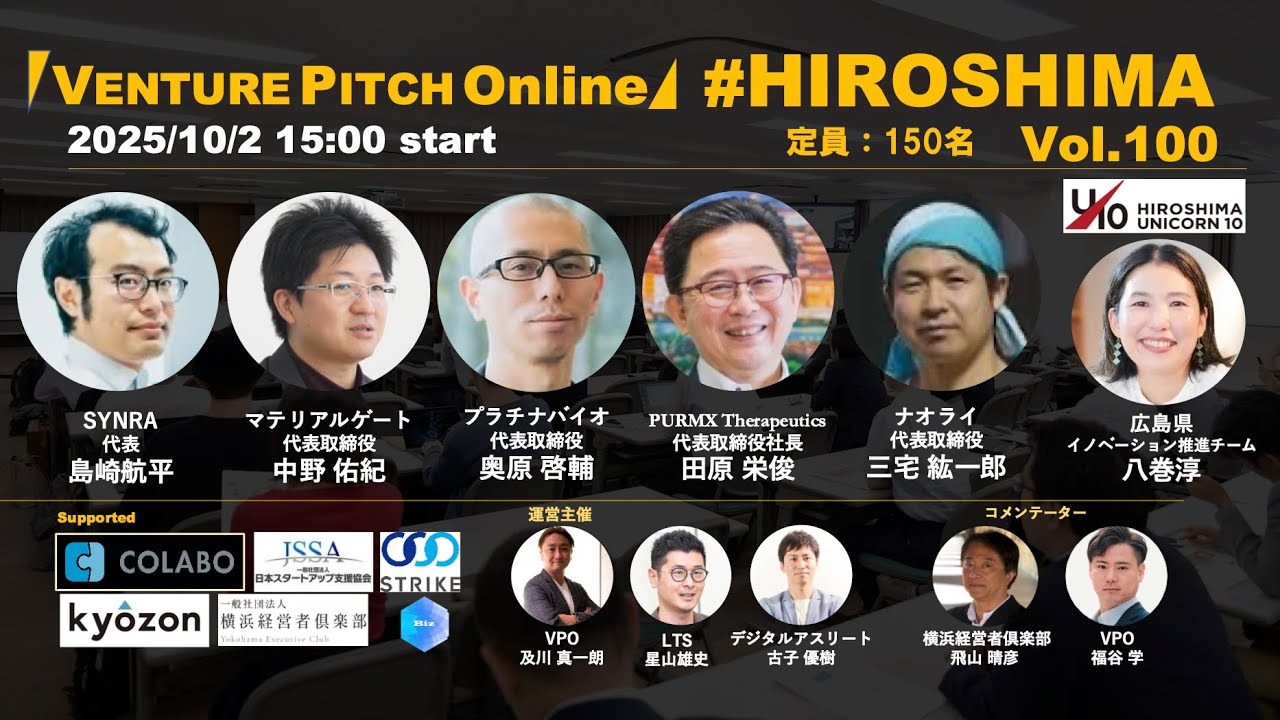
Thank you very much, everyone. My name is Hidetoshi Tahara, Representative Director and CEO of PURMX Therapeutics Inc.
Our company is a biotech enterprise developing innovative therapeutics for "refractory cancers," for which existing treatments do not work, amid the uncontrolled proliferation of cancer cells in our bodies. Founded in January 2021, we have been advancing our development with investments from many VCs and investors supporting advanced medicine and deep tech, including Osaka University Venture Capital, Yokohama Capital, and K-HAUS Innovation.
Our value proposition is to bring breakthroughs with new mechanisms against all difficult barriers in cancer treatment faced by many patients, such as "drug resistance to anti-cancer drugs," "severe side effects and toxicity that significantly damage quality of life (QOL)," and "recurrence or metastasis that reappears even if the cancer temporarily shrinks or disappears."
The biggest reason why cancer becomes refractory is that cancer cells have the "ability to proliferate infinitely" in our bodies, which inevitably leads to the acquisition of resistance to anti-cancer drugs. Our solution to this is a therapeutic drug that cuts off the infinite lifespan of cancer cells.
Specifically, we use a microscopic molecule in the body called "microRNA" to turn on the switch for "cellular senescence" in cancer cells. We call this the "aging switch." Once this switch is turned on, cancer cells can no longer proliferate and are ultimately induced to die.
Let me explain a little about microRNA. As many of you may know, microRNA is a biomolecule drawing the most attention in the world today, having won the Nobel Prize in Physiology or Medicine in 2023. There are about 2,600 types of microRNA in our bodies. They do not make proteins themselves, but play the role of "fine-tuning" that exquisitely adjusts the function of genes (messenger RNA).
While general anti-cancer drugs target only a single gene, microRNA approaches multiple related gene groups simultaneously. Therefore, even if a gene mutation occurs in a part of the cancer cell to escape from the drug, other pathways are simultaneously blocked, giving it an extremely strong advantage of "not easily developing drug resistance."
65% Survival Rate Demonstrated in Malignant Pleural Mesothelioma. Clinical Trial Completed and FDA Orphan Drug Designation
Our first pipeline, "MIRX002," is a locally administered nucleic acid medicine combining this microRNA (specifically miR-3140) with our self-developed carrier peptide "A6K."
The mechanism by which this drug works to kill cancer cells is highly innovative. MIRX002 targets and blocks a specific molecule called "SLC7A11," which is indispensable for the survival of cancer cells. When this molecule is blocked, "ROS (reactive oxygen species)" rapidly accumulates inside the cancer cells, and the cancer cells are destroyed by "ferroptosis," an iron-dependent cell death (a new death route different from apoptosis). This target molecule (SLC7A11) is an extremely powerful cancer treatment target that major pharmaceutical companies are paying attention to, even launching joint development consortiums.
In experiments using animal models (mice), astonishing effects have already been confirmed. For mice replicating "malignant pleural mesothelioma," an extremely refractory cancer caused mainly by asbestos inhalation, administering the drug for only three days (three times) led to the cancer shrinking and disappearing thereafter without any additional administration, demonstrating a breakthrough survival rate of 65% and therapeutic effect.
Currently, we are advancing Phase I/II clinical trials (01 and 02 studies) to verify safety and efficacy in humans. We have recently successfully completed the administration phase of the studies and are in an extremely exciting stage waiting for data analysis.
Furthermore, we are also advancing the development of a "systemic administration" pipeline, "MIRX006," which can approach advanced or metastasized cancers beyond local administration, and is about to enter the non-clinical study phase soon.
Our development speed is global. For expansion into the U.S. market, we have already completed a pre-IND meeting with the U.S. Food and Drug Administration (FDA) and obtained "Orphan Drug Designation" for malignant pleural mesothelioma from the FDA.
With this, preparations to start global clinical trials are complete, and we are ready to quickly enter global clinical trials (basket trials), including in the U.S., as soon as the funds are raised.
$30 Million Fundraising and Global Expansion. Aiming for License-Out via Partnerships with Drug Delivery (DDS) Companies
Our commercial strategy is to first aim for early drug approval for the rare cancer malignant pleural mesothelioma, and then sequentially expand indications to "head and neck cancer" and "lung cancer," which have large patient populations and markets.
In head and neck cancer, we are currently conducting clinical trials in Japan, injecting MIRX002 directly into neck tumors before surgery and analyzing the cancer tissues removed during the subsequent surgery. This allows us to directly demonstrate whether the drug actually reaches the cancer cells, presses the aging switch as designed, and induces ferroptosis. Positive data has already been obtained from the analysis of the first case, serving as powerful evidence (verification material) for licensing out our technology to major pharmaceutical companies (mega-pharma).
As a future prospect, we are also developing a combination therapy that combines MIRX002 with immune checkpoint inhibitors (ICIs) like Opdivo, destroying the cancer's immune evasion mechanism and multiplying the therapeutic effect.
To deliver this innovative microRNA therapeutic drug to patients worldwide, we are currently launching a Series B global fundraising of $30 million (approx. 4.5 billion yen). The fundraising period is expected to be within one year in fiscal year 2025. In parallel with equity investments from prominent domestic and foreign VCs, we are advancing capital and business alliances with major chemical and pharmaceutical companies (currently in specific discussions with two companies) that possess advanced "DDS (drug delivery system, lipid nanoparticles, etc.)" technologies essential for delivering our nucleic acid drugs to targets in the body.
Our development team consists of the strongest members capable of leading from drug creation to the success of global clinical trials, including Takahashi, who has over 30 years of global clinical development experience in the oncology field, Yasumoto, a professional in regulatory affairs, and a CFO leading global finance and fundraising.
With this world's first cancer cell "aging switch" technology, we will do our utmost to bring hope and smiles again to refractory cancer patients and their families who are in despair due to the lack of treatments. Thank you very much for your support and partnership.
Q&A and Feedback
Commentator (Mr. Toyama): Thank you very much, Mr. Tahara, for your very encouraging and grand pitch that changes the future of medical care. The approach of making cancer cells themselves "age" so they can no longer proliferate, and further inducing self-destruction through a new mechanism called ferroptosis, will be a paradigm shift in cancer treatment.
As a question, regarding the pipeline under development, could you tell us the reason why you raised the priority of "head and neck cancer" as an early main target in addition to malignant pleural mesothelioma? In terms of patient numbers and market size, stomach cancer or lung cancer would be larger, so why did you choose the direct injection approach in head and neck cancer?
Mr. Tahara: Thank you for the question.
The reason why we chose malignant pleural mesothelioma, a rare cancer caused by asbestos, as the first target is that there are almost no existing therapeutic drugs, and it has the greatest impact as a social issue solution.
However, because malignant pleural mesothelioma is injected into the thoracic cavity around the lungs, we cannot check the shrinkage of the cancer or the "action of the drug" inside with the naked eye or direct sampling from the outside. We can only track the overall size with CT or MRI, making it difficult to show direct evidence to pharmaceutical companies that "cancer cells are actually dying under this mechanism."
In contrast, head and neck cancer is cancer around the neck and face, and it is possible to inject the drug directly into the cancer cell with a syringe from the outside. Furthermore, in this clinical trial, we adopted a protocol of "administering the drug immediately before removing the cancer by surgery." This allows us to collect real human cancer tissues removed in surgery and directly analyze whether the drug has penetrated at the molecular level, blocked the target SLC7A11, generated ROS, and aged and killed the cancer.
Currently, the analysis of the first case has finished, and positive data exactly according to our hypothesis has been obtained. If we can show this "proof of concept (PoC)" that the drug actually works as visual and scientific data to pharmaceutical companies, we can dramatically increase our bargaining power for licensing out negotiations. This is the biggest strategic reason why we raised the priority of the head and neck cancer clinical trial.
Mr. Toyama: I see. Direct verification of the drug efficacy mechanism in human tissues and showing the data to major pharmaceutical companies will be your biggest weapon to draw out giant early licensing deals. It is a very precise and convincing strategy. At my age, the threat of cancer is very close, so I sincerely hope this drug will come out to the world soon.
Another point: regarding this Series B fundraising of $30 million, could you tell us the image of the period and investors? What kind of companies or VCs are you assuming?
Mr. Tahara: Regarding the fundraising schedule, we plan to start in earnest around February or March 2025 and aim to close within one year.
The partners we assume are global biotech-specialized VCs and chemical and pharmaceutical companies that possess advanced DDS (drug delivery system) or LNP (lipid nanoparticle) technologies essential for nucleic acid drugs.
Even if there is a wonderful therapeutic molecule in nucleic acid drugs, it cannot function without DDS technology (delivery technology) to deliver it to cancer cells without breaking it. Currently, we are already in specific discussions with two major companies possessing such excellent DDS technologies for capital alliance and joint development of technology licensing. By combining alliances with such business companies and equity fundraising from VCs, we want to secure $30 million early and advance the FDA clinical trial in the U.S. all at once.
Mr. Toyama: DDS alliances with business companies and hybrid fundraising from VCs, this is also a rational and solid plan. I feel that the team is aligned with the strongest members who can compete globally, so I am fully supporting you to deliver this innovative drug to cancer patients worldwide as soon as possible. Thank you very much.
Mr. Tahara: Thank you very much.