【SYNRA Inc.】3D Visualization of Infrastructure Vibration Using Camera Images. Non-contact, Real-time "Vibration Distribution Sensing" to Measure the Lifetime of Industrial Plants
Aging Infrastructure in Inaccessible Extreme Environments and the Limitations of Contact Sensors
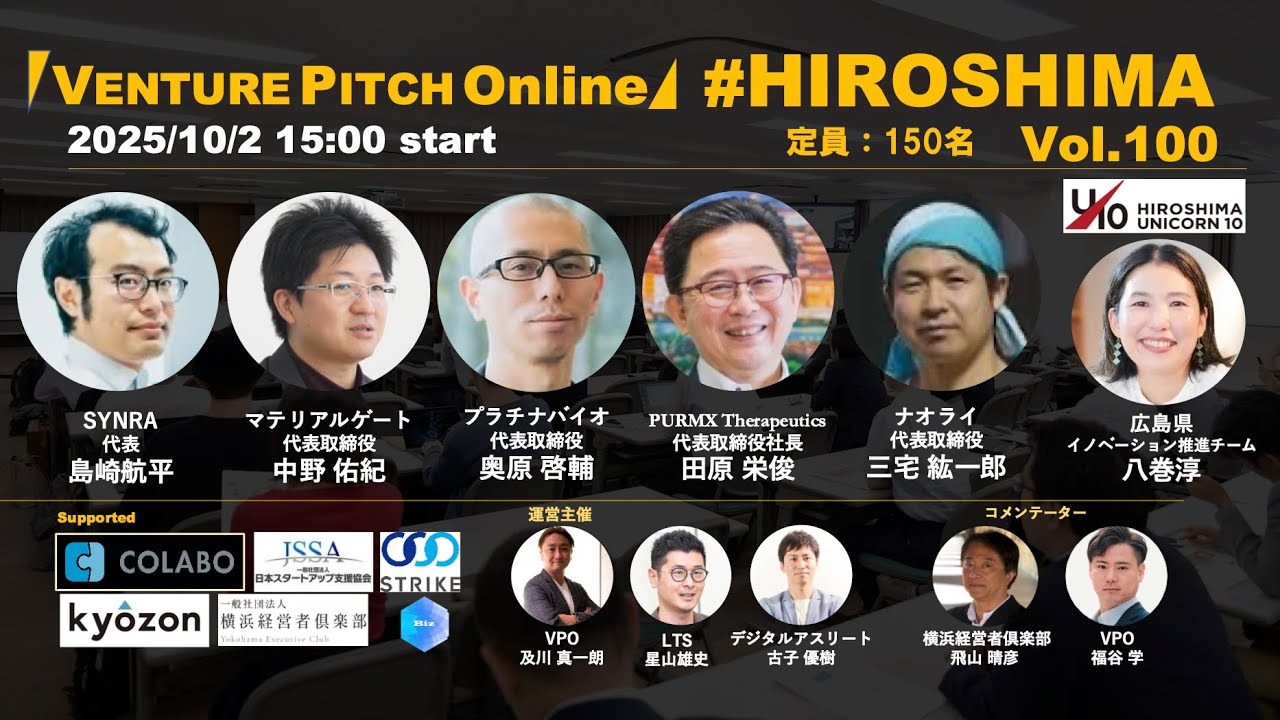
Thank you very much, everyone. My name is Kohei Shimazaki, Representative Director of SYNRA Inc.
Our company was just founded last month on September 4th, making us an extremely early-stage startup that has only just taken its first breath. However, even before our founding, we received strong support from Hiroshima Prefecture and various startup support programs, as well as intellectual property assistance, which has allowed us to stand on this pitch stage today.
We have a strong ambition to target the global market from the very beginning, and we are challenging ourselves to develop technology that will change the way industrial infrastructure is managed, with a team centered around multinational members and engineers.
The issue we are focusing on is innovation in "predictive maintenance" for large-scale industrial infrastructure, such as plants and bridges.
Currently, the decline in the number of maintenance technicians due to a declining birthrate and aging population, the increasing amount of aging equipment, and the dependency on individual skills in maintenance work have become serious issues across society. The number of locations that must be inspected and measured in various plants and social infrastructure continues to increase.
However, at the sites of chemical plants and large-scale factories, there are many "extreme environments where it is extremely dangerous for humans to even approach," such as high altitudes, high temperatures, high pressures, and toxic gas risks. There was a critical on-site challenge in these locations: it was fundamentally difficult to physically install measurement sensors in the first place.
Conventionally, to detect abnormalities in machinery, physical sensors such as "accelerometers" were directly attached to the target object to measure vibration. However, contact-type sensors can only measure at "spots" (points), making it impossible to grasp the comprehensive "vibration distribution" of the entire facility. Furthermore, the cost and effort required to attach and wire sensors to tens of thousands of points was enormous.
As another approach, technology to analyze vibration using camera images also exists. However, most conventional technologies capture large-volume videos for a short time with high-speed cameras and then analyze them later in batches, which takes a lot of time. This made real-time continuous monitoring and efficient data accumulation difficult.
We have resolved this issue using "high-speed camera image analysis" and "3D coordinate mapping" technology, developing a system that automatically detects the three-dimensional vibration distribution of entire facilities in real time and without contact.
3D Vibration Mapping with Two High-Speed Cameras. Wide-Area Scanning Enabled by Patent-Pending "High-Speed Gaze Control"
Our solution is a system that installs a high-speed camera facing the target machinery or equipment, and analyzes the "invisible, minute movements (vibrations)" reflected in the video using an algorithm.
Vibration of machinery is, so to speak, a medical chart showing its "health condition." By detecting how the vibration in each part has changed compared to the previous measurement or reference value, we can capture signs of trouble.
With our system, high-precision predictive maintenance is achieved through the following steps:
1. Non-contact Camera Measurement: Simply by filming the target with a high-speed camera from a distance, vibration information can be obtained without physical contact.
2. Three-Dimensional Stereo Measurement: By using two cameras, we measure the "three-dimensional vibration information (3D dynamics)" of the target object using the principle of triangulation.
3. 3D Visualization of Measured Data: By inputting the measured vibration data onto a 3D model (such as CAD data) of the facility obtained by scanning in advance, the minute movements are displayed on the screen with exaggeration for easy understanding.
We have developed a sophisticated analysis algorithm that not only visualizes the overall vibration but also decomposes the obtained vibration data for each frequency. This makes it possible to evaluate the "intensity," "occurrence position," and "time-series changes" of each vibration individually and continuously. Users can construct an extremely rational and planned maintenance schedule (integrated PDM solution), such as: "The vibration at this frequency at this connection part of the pump has been gradually increasing since last week. Let's perform maintenance this month."
Our core patent-pending technology (intellectual property) is not limited to this analysis algorithm. We also hold a patent for a "device design that controls and moves the camera's gaze (angle of view and focus) at an extremely high speed."
This high-speed scanning technology demonstrates overwhelming efficiency compared to other companies, especially as the measurement range becomes wider.
Furthermore, because our real-time processing capability is extremely high, we aim to develop a "smart infrastructure inspection model" where cameras are mounted on moving bodies such as "drones" or "UGVs (unmanned ground vehicles)" to automatically patrol plants and scan the vibration of entire facilities without contact, rather than just filming from fixed cameras.
Degradation Prediction via Subscription and the Value Chain Connecting Manufacturing and Infrastructure
Our business model assumes a combination of the initial camera hardware and software "package introduction" and a "subscription (SaaS)" that provides data analysis tools and abnormality detection dashboards through the cloud.
Based on real-time vibration data accumulated in the cloud, we will provide "automatic abnormality detection," "degradation score calculation for each part," and "optimal repair plan proposals by AI" in a digital coordinate space.
Currently, we have started proof-of-concept (PoC) projects with domestic manufacturing partner companies.
One example is a PoC in the pre-shipment inspection of large pumps for plants.
Conventionally, for manufacturers to inspect abnormal vibrations in pumps before shipment, they had to install a large number of physical sensors, which required huge amounts of time and labor. Furthermore, even if unexpected trouble occurred after shipment, it was difficult to identify where the cause lay.
By introducing our system, not only can the pre-shipment inspection time be significantly shortened, but we can also clearly feedback "which part of the design is under load and how to improve it to suppress vibration" to the design team as visual data, which has received high praise.
In the future, we will strengthen alliances with manufacturers who produce and evaluate "structural parts, seismic isolation rubbers, and members" for road infrastructure such as bridge piers and joints, as well as companies conducting durability tests for automobile parts, in addition to the plant equipment itself.
Although we are a young team just founded, we are promoting our business with all our strength to build a new digital coordinate space that protects the safety of global infrastructure. We look forward to hearing from partner companies that would like to proceed with technology demonstration and practical application together. Thank you very much.
Q&A and Feedback
Commentator (Mr. Furuko): Thank you very much, Mr. Shimazaki, for your extremely interesting and advanced presentation. In the midst of a declining birthrate, aging population, and labor shortage, measuring aging industrial plants and infrastructure "from a distance without contact using cameras" will indeed be a powerful solution to the challenges faced by local governments and the manufacturing industry.
As a question, you mentioned that you are receiving strong support from Hiroshima Prefecture in terms of intellectual property. Could you tell us a little more about the strengths of the patent-pending technology (intellectual property) you possess?
Mr. Shimazaki: Thank you for the question.
The patents we possess can be broadly divided into two areas.
One is the area of "analysis algorithms" that remove noise from filmed footage to accurately extract minute vibrations on the scale of millimeters or even microns.
The other is a design patent related to a "control device that moves the camera's gaze extremely quickly on a millisecond scale."
Other companies' camera vibration analysis can only measure what is reflected within the angle of view of a fixed camera. However, because our technology scans while changing the focus and orientation of the camera at high speed, the area and number of targets that can be covered by a single camera increase dramatically. This "fusion of a high-speed gaze control device and algorithms" is our core patent-pending technology, which other companies cannot easily copy when measuring vast infrastructure.
Mr. Furuko: I see. It's a combination of hardware and software that doesn't just target a part with a fixed camera, but controls the camera itself at high speed to scan a wide area in one go.
Another point: in comparison with competitors, the keyword "continuous monitoring" came up. Is this assumed to be a system where cameras are fixed and monitor continuously, or is it a "spot patrol inspection" mounted on drones to detect abnormalities from data at the moment of filming? Which operation are you currently assuming?
Mr. Shimazaki: To conclude, we support both operations.
In the case of fixed monitoring (continuous monitoring), we can install cameras permanently, process vibration data in real time, and issue alerts the moment a reference value is exceeded.
On the other hand, our technology also demonstrates great strength in "spot patrol inspections" mounted on drones or mobile robots (UGVs). This is because our real-time processing speed is extremely fast, so even if the camera itself is moving (and blur occurs), we can automatically offset the effect of the movement blur and accurately measure only the vibration of the target object. Therefore, simply by taking a quick video of a bridge or plant with a drone as it passes by, it is possible to instantly obtain 3D vibration distribution data and map abnormalities.
Mr. Furuko: Being able to offset movement blur and measure vibration even when the camera is moving is an extremely practical breakthrough for drone inspections.
Finally, in implementing this technology in society moving forward, specifically "what industries of companies" do you think will generate synergy by partnering with?
Mr. Shimazaki: We are particularly seeking collaboration with people in two industries.
One is manufacturers that produce or evaluate "structural parts, seismic isolation rubbers, and members" of infrastructure such as bridges. By using our system, we can visualize the stress and vibration distribution on members in 3D as measured data, contributing to the advancement of design.
The other is "parts manufacturers" for automobile chassis, engines, etc. In manufacturing lines and durability tests, the enormous labor previously spent on attaching sensors can be reduced, and it can function as an infrastructure to evaluate vibration durability immediately and without contact.
Mr. Furuko: For manufacturers who spend costs on "measuring and addressing vibration," such as infrastructure member manufacturers and automobile parts evaluation processes, this is indeed a technology that leads to cost reduction and accuracy improvement.
Although you just founded the company last month, I feel the potential of the technology is very high. I have great expectations for the progress of your future alliances and practical application. Thank you very much.
Mr. Shimazaki: Thank you very much.