【Teach Inc.】Preventing "Family Collapse" Caused by Overheated Junior High School Exams. "Teach," a Home Learning Gig-Work App Matching Students with Elite Tutors Without Interviews Under a Time-Saving Model
Junior High School Exams Increasing for Nine Consecutive Years. Knowing the Crisis of Family Breakdown and Communication Breakdown Firsthand
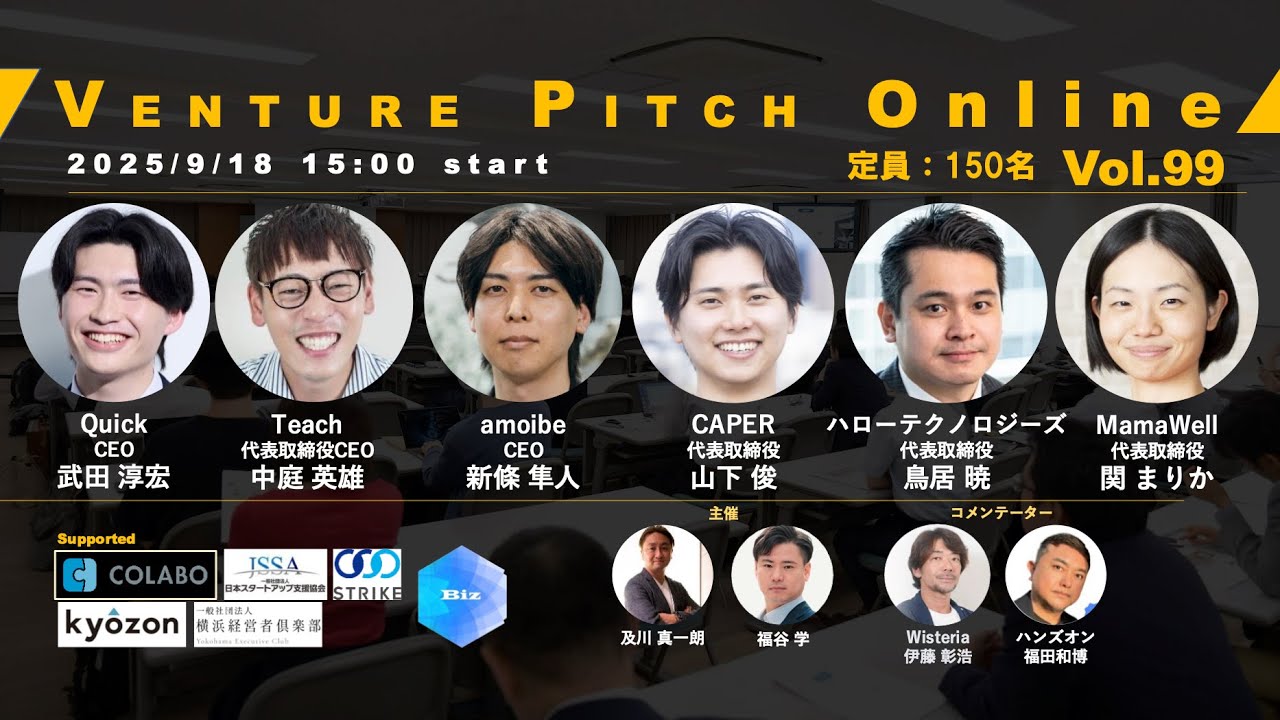
Thank you very much, everyone. My name is Hiroshi Nakaniwa, Representative Director of Teach Inc.
I started my career as a teacher at a correspondence high school in a very rural area of Nara Prefecture. About 80% of the students there were so-called delinquents or shut-ins, and it was a lively environment where everyone commuted on loud motorcycles. Deeply interacting with them, I wanted to change the reality that many students graduated without deciding on their next steps or employment, so I started recruitment support programs for high school graduates while in college.
In recognition of these achievements, I was entrusted with the Ministry of Health, Labour and Welfare's "Regional Youth Support Station (Saposute)" project, operating labor consultation facilities for local NEETs and shut-ins. Later, I founded Career Assist System Co., Ltd., developing labor consulting and recruitment businesses, growing to support approximately 600 client companies.
Amid such a career, the new business I launched to cut deep into the "educational relationship between parents and children" is this home learning companion app, "Teach."
Behind my passion for this business is my very bitter personal experience.
When I was an elementary school student, I had a very happy life with friends in rural Nara, but my life changed completely when I challenged junior high school exams. When school ended, I traveled an hour to a prep school in Osaka, studied late into the night, came home, and did my homework. On weekends, I studied and took tests from morning to night, living a study-obsessed life.
As a result, I was extremely exhausted mentally and physically, and my parents scolded me constantly about my grades. From the latter half of elementary school, I couldn't have any normal conversation with my parents, and eventually, I ran away from home at the age of 17, resulting in a serious "family collapse" where I couldn't see my parents for 10 years.
Today, "junior high school exams" in Japan are abnormally overheated. Despite the declining birthrate and decreasing child population, the number of exam-takers has "increased for nine consecutive years," and more than half of elementary school students in metropolitan areas are taking exams. The motive is often parent's anxiety, not wanting their children to go to local public junior high schools. However, this overheating causes parent-child relationships to deteriorate irreparably, leading to family breakdowns nationwide.
Essentially, family happiness should mean family members spending time together with smiles. We want to solve the reality where junior high school exams break family ties with technology and a new mechanism.
2,000 Tutors Registered Without Interviews or Tests. An "Uber of Education" Matching System Pursuing Time-Efficiency
In modern Japan, nuclear families and double-income households are rapidly increasing, making it extremely difficult for parents to accompany and support their children's home learning every day.
This is where our home learning companion app "Teach" comes in.
For parents and students, it is a system where they can easily search for a tutor on the app based on their current study concerns, target schools, preferred teaching style, and personality, and reserve and pay for a session on the spot. On the other hand, for university student and adult tutors, it is a "gig work" platform where they can effectively use their free time, teach subjects they excel in, and immediately receive rewards.
Like reserving a hair salon with Hot Pepper or ordering food with Uber, the biggest feature is that there is no admission fee, and you can request a class on a one-off basis when needed.
Currently, without spending marketing costs, we have registered "more than 2,000" highly excellent tutors purely through word-of-mouth. Not only students from prestigious universities like the University of Tokyo, Kyoto University, and medical schools, but also former prominent professional instructors from major prep schools and professional home tutors have gathered.
We have provided more than 3,000 classes so far, maintaining an amazing average user review score of "4.97 (out of 5)." We have received many voices of gratitude, such as parents saying, "We achieved a turnaround pass from an E-grade," and "The moment I found Teach, I knew this was it," as well as tutors saying, "I was about to give up on home tutoring, but thanks to Teach, I can continue teaching in my spare time."
By outsourcing the most burdensome and delicate part of accompanying children's learning to Teach's excellent tutors, parents can step back and simply support and cheer for their children. This has successfully generated a positive loop in many households.
AI Voice Analysis of Classes Ensuring Safety. Roadmap from Junior High School Exams to B2B Daycare Alliance and Full Concentration
We have thoroughly eliminated the troublesome procedures of conventional home tutoring agencies and online education services by taking the opposite approach.
Conventional services require tutors to undergo face-to-face interviews, written tests, and manual training, forcing them to commit to shifts of several hours per week. In contrast, Teach requires no interviews or tests, allowing tutors to register their schedules and accept classes immediately once "academic confirmation" is completed by uploading their student ID or graduation certificate.
This overwhelming "time-efficiency" strongly appealed to elite science students at prestigious universities, who are busy with lab experiments and lectures and could not fit into the fixed shifts of conventional part-time jobs, leading to an explosive increase in registrations.
Of course, we have taken thorough system measures against concerns about teaching quality and security caused by skipping interviews and tests.
Classes between students and tutors are conducted online within the app, and all classes are automatically recorded and videoed. The voice data is analyzed by AI to automatically screen for abusive language or inappropriate instruction. Furthermore, since it is a one-off contract between the student and tutor, if they do not match well, the parents do not need to feel awkward and request a change; they can simply assign a different tutor next time. Thanks to this combination of "tutor liquidity" and "AI monitoring & high-touch customer support," no major trouble has occurred so far.
In the future, we will expand Teach's platform beyond junior high school students to high school students' test prep and university exams, and even "non-school studies" such as IT programming and painting.
We will also actively build B2B2C business alliances, such as home learning supplement alliances with junior high prep schools, and "providing the Teach tutor platform" to private daycare facilities that cannot secure resources to teach children.
To stake my entire life on Teach, I have made the decision to 100% succeed the businesses of the general incorporated association I was operating, and to proceed with succeeding Career Assist System to a successor, fully concentrating all management resources on Teach.
We will build an educational environment where all children can equally realize their dreams, regardless of family background or parental burden. We look forward to hearing from VCs and business companies who sympathize with our vision. Thank you very much.
Q&A and Feedback
Commentator (Mr. Fukuda): Thank you very much, Mr. Nakaniwa, for your passionate and extremely waste-free presentation. Having been involved in launching a home tutoring business during my university days, I deeply sympathize with the difficulty of matching in home learning and the heavy burden on parents.
As a question, registering 2,000 excellent tutors with zero marketing cost is amazing. General tutoring agencies spend huge advertising budgets on tutor recruitment, but why are science students at prestigious universities and famous professional tutors gathering at Teach at such speed? Please tell us the "core rules that appealed to tutors" that you have analyzed.
Mr. Nakaniwa: Thank you for the question.
What appealed most to tutors, especially excellent science students at prestigious universities, was the overwhelming "time-efficiency (tapa)" of registration.
Excellent science students are extremely busy with daily experiments, report writing, and lectures, making it very difficult to do conventional part-time jobs with fixed shifts like "always going at a certain time on a certain day of the week." Furthermore, going to face-to-face interviews, taking written tests, and watching training videos for hours during registration was a huge opportunity loss for them.
With Teach, no interviews or written tests are conducted, and registration is completed immediately upon "academic confirmation" just by uploading images of student IDs or graduation certificates. If they drop their schedule for just one free hour into the app, parents will automatically apply for classes. This "gig work model perfectly fitted to the spare time of busy science students" became a unique attraction for them and spread rapidly through word-of-mouth.
Regarding quality control despite skipping tests, we resolve it by accumulating "real review evaluations from parents" after classes. Tutors with low ratings naturally receive no reservations, and work concentrates on excellent tutors with high ratings, maintaining a high-quality instruction system through market principles.
Mr. Fukuda: I see. Eliminating the "troublesomeness" of interviews and fixed shifts perfectly matched the needs of busy, excellent students.
Another point: in one-on-one education, because it takes place in a closed room, troubles due to tutor attitude, mismatch with students, and complaints from parents are common. Against this, how does Teach manage quality and cover trouble response?
Mr. Nakaniwa: That is precisely the area where we invest the most technology to cover.
First, regarding compatibility, we eliminated the constraint of "continuing to contract with one tutor" like conventional home tutoring, and made it a "one-off contract with zero admission fee." Therefore, if the compatibility is not good, parents do not need to feel awkward and ask for a change; they can simply reserve a different tutor next time.
For safety management and teaching quality checks, all classes are recorded and videoed within the app. We run all class voice data through AI text analysis, implementing a system that automatically screens whether the tutor's language is appropriate and whether inappropriate communication has occurred.
If an abnormality is detected by AI, or if a parent raises an alert through the app, our customer support immediately checks the recorded data and handles refund processing, individual instruction, or account suspension for the tutor through high-touch (手厚い) support. This combination of "AI monitoring and high-touch support" ensures safety and reliability higher than conventional agencies despite one-off matching.
Mr. Fukuda: I see. Automatic screening by AI voice analysis of all classes and high-touch response during troubles. This is a solid system that private daycare facilities can safely entrust partnership with.
Finally, regarding the funding and partnerships you are assuming, specifically what kind of VCs and business companies do you want to meet, and what synergies do you expect?
Mr. Nakaniwa: We are particularly seeking partnerships with two types of partners.
One is business companies operating "private daycare facilities" or "parenting support services" that have networks with double-income power-couple households. Securing excellent human resources to teach children is a big challenge for them, but by providing our platform of 2,000+ tutors during daycare learning hours, it generates a synergy of adding powerful educational content.
The other is venture capital (VC) firms that have strong connections in such education/parenting industries and know-how in business succession.
To fully concentrate on Teach, I am advancing the succession roadmap of my existing business. We look forward to hearing from investors who will promote this concentration and B2B diversification together to update the state of education in Japan.
Mr. Fukuda: B2B2C alliances with daycare facilities and full concentration on Teach through business succession, this is an excellent determination and strategy. As a former tutoring player, I deeply sympathized and felt the high potential. I look forward to Teach's rapid growth. Thank you very much.
Mr. Nakaniwa: Thank you very much.